Blog Tag Cloud

703-391-8911 BASF Construction Chemicals beam inspection building permit Building permits buried downspout extensions civil engineer Civil engineering concrete cracks concrete no cracks concrete spalling construction inspection Construction inspections construction soil inspection crack in foundation wall crack-proof concrete Creative Demolition plan drainage Engineering design engineering inspection Engineering inspections erosion excellent engineering services Expert exposure to corrosive elements footing inspection Foundation design foundation failure foundation inspection Foundation inspections foundation settlement foundation wall bowing Foundation wall movement Framing design framing inspection framing plan Geotechnical engineering given clear and concise reports and where needed grading plan ground shifting He has always made a careful analysis of the situa High Integrity home inspection Ken Fraine Land planning myblog poor drainage preventative measures rebar corrosion residential design-build projects retaining wall Retaining wall design retaining wall failure retaining wall inspection See what people are saying about Soil & Structure septic field Septic fields Site plan snow infiltration Snow Melt soil and structure soil and structure consulting Soil Consulting dc Soil Consulting maryland Soil Consulting virginia soil depression in crawl space soil engineer soil scientist soil structure virginia Structural design structural engineer Structural engineering structural inspection structural Inspection & Repair Structural inspections Structure Consulting dc Structure Consulting maryland Structure Consulting virginia truss design Water quality assessment What can you do to prevent surface water infiltrat Zero Crack Concrete zero-cracking

Soil and Structure Consulting

Blog & News

Francisca V. Alonso has endorsed Ken Fraine as President at Soil & Structure Consulting, Inc.
"We have worked with Ken on various residential design-build projects and his company has provided us with excellent engineering services. We highly recommend Ken and Soil & Structure Consulting for all your engineering needs. Great results! Great professionals to work with!" ?Service Category: engineering?Year first hired: 2004 (hired more than once)?Top Qualities: Expert, High Integrity, Creative


See what people are saying about Soil & Structure in Maryland, DC and Virginia
 
Jerome P. Friedlander, II(client)
Jerome P. hired you as a soil and structural engineer in 2003 and hired you more than once
Top qualities: Great Results, Expert, High Integrity
 
“I am an attorney. I have worked with Ken in his capacity as a soil and structural engineer in cases involving those issues going back approximately 10-years or more. He has always made a careful analysis of the situation, given clear and concise reports and where needed, testified in court as my expert. He is highly qualified and an excellent engineer. I highly recommend him to anyone in need of his services.” March 2, 2011
 
Carol Greco, CRS, GRI(client)
Carol hired you as a Structural Engineer in 2000
Top qualities: Great Results, Personable, Expert
 
“Ken is a great structural engineer. He determines the facts and presents them in a clear and understandable way.” March 2, 2011
 
Dave Crowley, Owner, DJJC Co., Inc. (business partner)
was with another company when working with you
“I have worked with Ken on a number of projects where his firm did the structural analysis of homes and recommended the technique that our firm uses as one of the proposed methods of repair. Ken and his team take the time and effort to find the underlying problems with the structure and/or soils and then gives his clients appropriate options for repair.” March 2, 2011
 
Noel Sweeney(client)
Noel hired you as an ENGINEERING CONSULTANT in 2007
Top qualities: Personable, Expert, High Integrity
 
“I consulted with Ken on a property I was thinking of purchasing a few years back in Arlington. There was significant structural damage and Ken was able to advise me on the corrective steps and an approximate cost to correct the issue. I found his fees were very reasonable and he was very professional along with the fact that he is a pleasure to deal with. I would not hesitate in recommending Ken to my clients.” March 2, 2011  
Amy Stanley(client)
Amy hired you as a General Contractor in 2004 and hired you more than once
Top qualities: Great Results, Expert, High Integrity
 
“Ken Fraine is the go to Engineer in Northern Virginia. As a real estate agent, I have hired Ken for structural inspections of houses. His expertise have been beneficial to my customers.” March 2, 2011
 
Doug Francis(client)
Doug hired you as a Structural Engineer in 2006 and hired you more than once
Top qualities: Personable, High Integrity, Creative
 
“I referred Ken to a few clients who needed a structural engineer to examine foundation cracks in their homes. In each case they were pleased with his understanding of the situation/issue and his ability to provided remedies for repairing their homes.” March 3, 2011
 
Jay Markanich, Principal, Jay Markanich Real Estate Inspections, LLC (colleague)
worked directly with you

“I have known Ken Fraine for about 15 years. The group of people who I refer professionally represent a very short list! We first met during a home inspection as I watched him deal with a structural issue and explain to the (our) clients what was going on. Since that time I have referred Ken for many reasons - structural and soil issues - and have never had a client report to me that they felt very pleased with his service and treatment of them. I will continue to refer Ken when I run into structural or water issues that I feel are best referred to a professional engineer. Like me, he seems to go everywhere with his service, which removes geography as a concern when a client has a need. He has continually been quick to respond when my clients have a need. Ken makes it easy to feel comfortable with him as an individual and as an engineer. I am proud to have a business affiliation with him and this is a business relationship that I will continue to trust. Jay Markanich” March 3, 2011
 
Amy Stanley(client)
Amy hired you as an Engineer in 2006 and hired you more than once
Top qualities: Personable, Expert, High Integrity
 
“Ken has been hired by my clients to provide a structural evaluation of their residential properties. I have personally have hired Ken to evaluate my personal residence. On time, reliable reports.” January 17, 2011


Foundation Wall Movement
Foundation problems should be addressed as soon as they are discovered and before the damage is irreversible. The two most common types of foundation failures are foundation settlement (vertical movement of the footers) and foundation wall bowing (lateral movement of below-grade walls).
Foundation Settlement
Typical signs of foundation settlement are stair-step cracks and vertically sheared bricks or blocks. The direction of the cracks is very important in determining whether the foundation wall movement is vertical or lateral (bowing) as the remediation design is entirely different.
The most common and typically most economical method of repairing failed foundations that have settled is to install a series of steel underpinning piers below the affected foundation area. The concept is founded on the principle of turning or pushing an anchor into stable subsoil strata until the torque or pressure applied indicates that the necessary load capacity has been achieved. The load-bearing steel shafts are screwed into the ground independent of the structure and their bearing or holding capacity is verified as the system is installed.
Adjustable brackets are then attached to the base of your foundation walls, connecting the anchors to the foundation. The weight of your home is then shifted to the anchors. In the process, foundations, walls and floors are repositioned (i.e. "jacked up") and retained from further movement.
Bowed Foundation Walls
Bowing walls will commonly have a long horizontal crack starting 3 to 6 feet from a corner foundation to the opposite corner of the same wall and terminate into stair-step or diagonal cracks leading to the ceiling or floor.
The three most common remedial methods of stabilizing bowing walls are installing a series of (1) vertical strut or I-beams, (2) wall anchors or dead-man anchors, and (3) carbon strips. Each method has its own advantages and disadvantages and not all methods can be used in every situation. An SSC structural engineer can typically determine the most appropriate remediation method based on a visual observation of the failed wall.
Foundation Contractors
Foundation remediation systems should only be installed only by experienced foundation repair contractors who have been certified by the manufacturer of the system used.
www.soilandstructure.com
info@soilandstructure.com
703.391.8911 p
703.995.4680 f


BEACHWOOD, Ohio - BASF Construction Chemicals has invented a new kind of concrete that it says will transform the $20 billion repair construction industry, because once it sets, it's virtually crack-proof.

BASF says its "ZERO-C" (zero-cracking) line of concrete is a stronger and more durable alternative to the mortars that usually repair - and re-repair - crumbling historic buildings and other older structures.

"This is like finding the cure for cancer for our industry," marveled Peter Emmons, founder and chief executive of Structural Preservation Systems, a specialty repair contracting company in Hanover, Md.

"It's pretty ground-breaking for restoration construction, taking concrete and actually improving its performance," agreed Dilip Choudhuri, principal and executive director of structural diagnostics services for Walter P. Moore engineering firm in Houston, Texas, which repairs bridges, stadiums and buildings.

ZERO-C will also be available for contractors repairing residential driveways, sidewalks, balconies and other projects.

The construction industry has spent decades looking for materials that won't crack when they are used to repair and reinforce older materials, because even hairline cracks can let in pollutants and start disintegrating the concrete.

"The goal of our industry is to stop repairing the repair," Emmons said.

click here to read more...

Original blog post by: http://www.cleveland.com/


Snow Melt
What can you do to prevent surface water infiltration from snow melt?
 
There are several preventative measures that you can take both before and after a snow event.
 
Before it snows:
 
1. Before it snows, be sure that the ground surface around the perimeter of your foundation wall has a positive grade (i.e., sloped away from the wall).
2. Check your gutters and keep them clear.  We highly recommend installing buried downspout extensions to take water from melting snow on your roof a safe distance away.
 
After it snows:
 
1. Keep the end of your downspouts clear so water can flow freely.
2. Avoid piling up snow along the foundation walls.
 
 
The "X-FACTOR" is below-grade foundation wall waterproofing.  Even with proper grading and downspout extensions, if you foundation wall isn't properly water-proofed below grade then water seepage can occur.  This is especially true for older CMU block walls as the blocks and mortar joints around them are fairly porous.  You should consult a SSC engineer if you have a concern about foundation waterproofing.


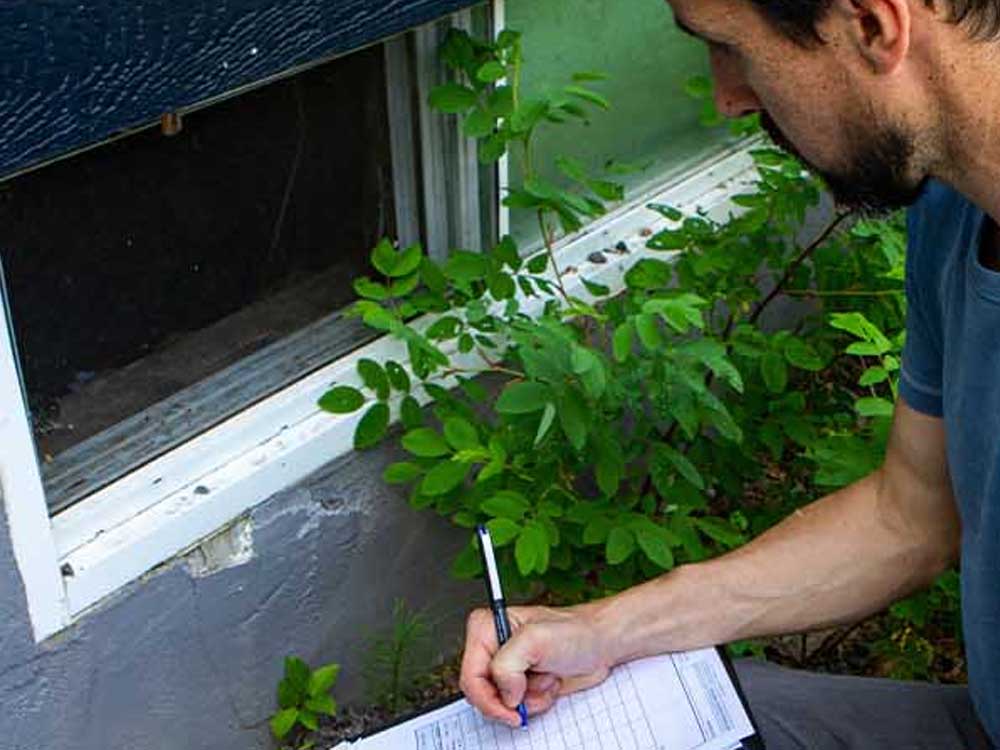
Here's a picture of some significant concrete spalling on the interior face of a foundation wall of a older home in Purcellville, VA.  This is the result of decades of water infiltration through the wood framing and plywood covering the access panel.  This problem can be fairly easily solved by simply installing a new window that is properly sealed.  The concrete wall itself is still intact and shows no other signs of damage.  
Spalling can also be the result of the freeze/thaw cycle, ground shifting, rebar corrosion, exposure to corrosive elements, or improper installation of concrete during the original construction.  Materials used for this type of repair include two-component, epoxy-based mortars that utilize silica and/or aggregate, polymer-modified cements or hydraulic cements, as well as additional materials specific to the customer’s repair needs.
 
Our recommendation to the homeowner was to install a new, properly sealed window and repair the concrete face as described above.


Foundation problems should be addressed as soon as they are discovered and before the damage is irreversible. The two most common types of foundation failures are foundation settlement (vertical movement of the footers) and foundation wall bowing (lateral movement of below-grade walls).

Foundation Settlement
Typical signs of foundation settlement are stair-step cracks and vertically sheared bricks or blocks. The direction of the cracks is very important in determining whether the foundation wall movement is vertical or lateral (bowing) as the remediation design is entirely different.

Bowed Foundation Walls

Bowing walls will commonly have a long horizontal crack starting 3 to 6 feet from a corner foundation to the opposite corner of the same wall and terminate into stair-step or diagonal cracks leading to the ceiling or floor.

At Soil and Structure Consulting we can help you with these and many other foundation problems:

beam inspection, building permit, civil engineer, civil engineering, construction inspection, construction soil inspection, crack in foundation wall, demolition plan, engineering design, engineering inspection, footing inspection, foundation design, foundation failure, foundation inspection, framing design, framing inspection, framing plan, geotechnical engineering, grading plan, home inspection, land planning, land planning, poor drainage, retaining wall, retaining wall design, retaining wall failure, retaining wall inspection, septic field, septic fields, site plan, soil and structure consulting, soil depression in crawl space, soil engineer, soil scientist, soil structure virginia, structural design, structural engineer, structural engineering, structural inspection, structure consulting, truss design, water quality assessment


Many other structural consulting firms will tell you their job is just to find problems or simply provide a design. We believe our job is to help you solve problems. We don't just perform an inspection or design and leave you with a list of issues and a bill. We work with you to determine the best solution for your property and budget, and then make that solution happen.
 
We specialize in almost 40 different services, ranging from inspection to design to remediation. You can learn more about all of them in our services. Some of our most popular services are:

alt alt alt
alt alt alt


We provide the following services:

Design Services      
Civil engineering Framing design Land planning Site plans
Demolition plans Geotechnical engineering Retaining walls Structural engineering
Foundation remediation Grading plans Septic fields  

Inspection Services      
Drainage & Erosion Foundation damage New construction Structural damage

Other Services      
Obtain building permits Water quality assessments